Шахматы — Правила
VOG — Vinco Online Games
Chess Rules
Chess is a game for two players. The game board consists of 64 alternating dark and light squares. The board is positioned so that the corner square to the right of each player is light.
The vertical lines of squares are designated by the Latin letters a through h, and the horizontal lines by the numbers 1 through 8. Any square on the board can be identified by a combination such as a1, c6, c8, f4, etc. The d and e files are called central files, the a, b, c, d files are called the queenside, and the e, f, g, h files are called the kingside.
Figure 1 shows the starting position of the pieces. One player plays with the light pieces, usually called "White", and the opponent plays with the dark pieces, usually called "Black". White always makes the first move, after which players alternate turns.
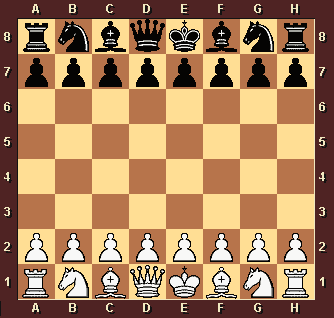
White's king starts on e1, the queen on d1, two rooks on a1 and h1, two bishops on c1 and f1, two knights on b1 and g1, and eight pawns on the second rank — on squares a2, b2, c2, d2, e2, f2, g2, h2. Black's king starts on e8, the queen on d8, two rooks on a8 and h8, two bishops on c8 and f8, two knights on b8 and g8, and eight pawns on the seventh rank — on squares a7, b7, c7, d7, e7, f7, g7, and h7.
How the pieces move
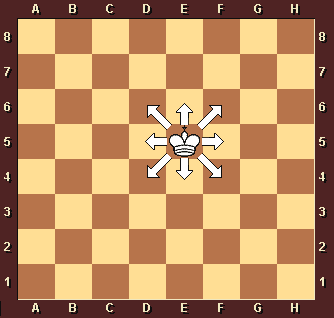
The King is the most important piece. From its square, it can move one square in any direction (Fig. 2).
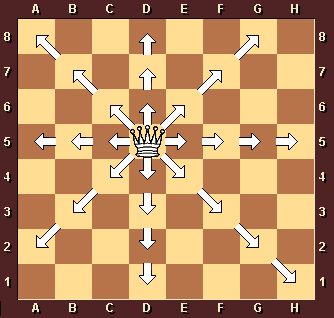
The Queen is the most powerful piece. From its square, it can move to any square along a file, rank, or diagonal, without jumping over other pieces (Fig. 3).
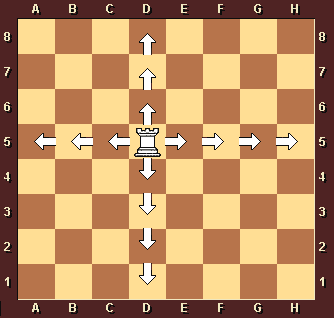
The Rook moves along straight lines — along a rank or file to any square, without jumping over other pieces (Fig. 4).
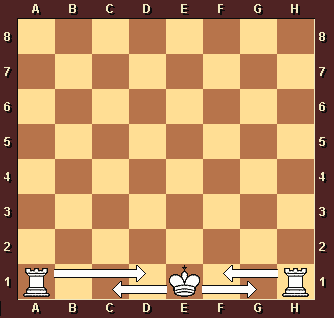
The Rook and the King participate in a special move called castling (Fig. 5). Each player may castle once per game, either long or short. Castling is only possible if neither the king nor the rook has moved since the start of the game, there are no pieces between them, and the king is not in check. Short castling for White: king e1-g1, rook h1-f1 (in one move). Long castling: king e1-c1, rook a1-d1 (in one move). Black castles analogously.
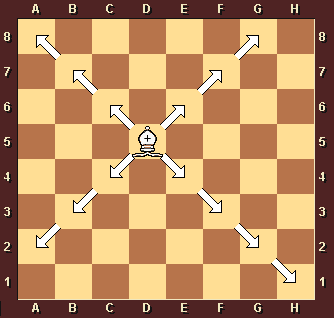
The Bishop moves diagonally from its square, without jumping over other pieces (Fig. 6). Obviously, a bishop can only move on squares of the color it originally stood on. A bishop that moves on light squares is called a light-squared bishop, and one on dark squares is called a dark-squared bishop.
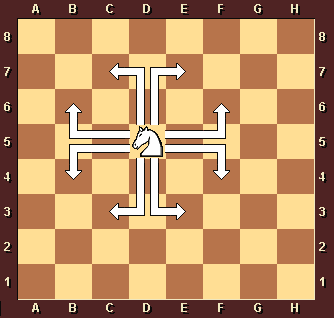
The Knight moves in an "L" shape — two squares along a straight line and one square perpendicular to it (Fig. 7). Thus, the knight changes the color of its square with every move.
The Queen and Rook are called major pieces, while the Knight and Bishop are called minor pieces. The Queen, Rook, and Bishop can capture an opponent's piece not only at the end of their path but on any square along their line of movement.
If a piece can move to a square, it can also capture an opponent's piece standing on that square.
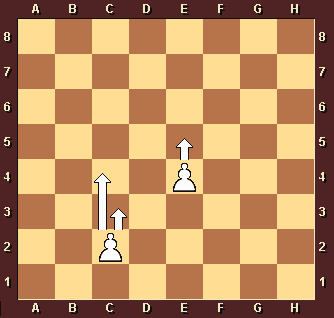
The exception is the Pawn — it moves and captures differently. A pawn moves one square forward (or optionally two squares on its first move in the game (Fig. 8)). A pawn captures diagonally, one square forward. Upon reaching the last rank (on the opponent's side), the pawn is removed and replaced by any piece of the player's choice, regardless of whether such a piece is already on the board.
The only piece that cannot be captured is the King. If it is attacked by an opponent's piece, this is called check. The King cannot remain in check and must escape on the next move. Check can also be blocked by interposing another piece. The final way to escape check is to capture the threatening piece. The King cannot move to a square attacked by an opponent's piece, nor can it move adjacent to the opponent's King.
If it is impossible to escape check, the player whose King is under attack is checkmated and the game ends — the player who delivers checkmate wins. The goal of the game is to checkmate the opponent. The game can also end if a player resigns. If there are time limits for moves or the entire game, a player may lose by exceeding those limits.
A game can also end in a draw. This may happen by mutual agreement at any position, or by stalemate (a player has no legal moves with any of their pieces).